Friday, May 22, 2009

"Francia o Spagna," Part II

The Southern Question...that is not the question!

Naples does not fit squarely either within discourses of Italian colonialism or of the Southern Question. As a stop on the Grand Tour, a repository of “Italian” culture and (Greco-Roman) history, as an urban capital, the Southern agrarian discourse of the likes of Franchetti and Villari noticeably omits Naples from its equations [9].

Although Neapolitans have been considered backward, superstitious, pagan, ignorant, villainous (like their Sicilian brethren), they do not seem to have been specifically targeted for immigration to Africa. Anthropologists of the southern Italy like Banfield and De Martino have focused on pastoral regions such as Lucania and the Salento, the most isolated areas untouched by external influences [10].

If anything, the relationship of Naples to Italian colonialism was as a cultural and psychological midway point between rational Italy and fantastical Africa, a sort of gateway to the dreamscape of the Red Sea [11].

Though a site for Italian colonial propaganda (e.g. La Mostra d’Oltremare), Naples was not re-dressed by the Fascists, and does not run parallel to the construction of the city of Asmara, for example, or of Eritrean identity vis-á-vis the Italian state [12].

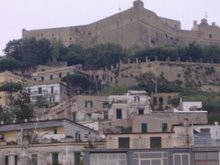
The divisions in Naples run along class, not racial, lines in vertical patterns: the rich on the Vomero hill, the poor below; the privileged few on the top floor of a palazzo nobile, the indigent many in the illegal street-level bassi.

It might be possible, however, to address contemporary Neapolitan identity in terms of Jorge de Alva’s sense of postcoloniality: “subjectivity ‘after’ the colonial experience as a subjectivity of oppositionality to imperializing/colonizing (read: subordinating/subjectivizing) discourses and practices”13].

I am thinking specifically about a Neapolitan “subjectivity of oppositionality” in which the foreign tout court is considered a colonizing force. “Siamo africani,” in this sense, speaks to being the ultimate Other, which I seek to demonstrate as the fundamental content and structure of contemporary napoletanità. Jane Schneider writes, “Within the political economic tradition, there is a compelling argument that the difficulties of the South are rooted in a colonial or near-colonial past” [14].

However, I hesitate to push Schneider and de Alva further because I am quite sure that the colonial/postcolonial framework is ultimately unsuited to understanding contemporary Neapolitan identity construction.

In the broadest sense, Naples and urban centers in general are not the focus of the Southern Question architects, in particular in the intermingling of the question with the Italian colonial project. Franchetti et al. concentrate on the southern peasantry: “Within parliamentary discussions of ‘demographic colonialism,’ agriculture came into focus as both the target and the apparatus of Italian rule” [15].

The poor, unskilled laborers of Naples would probably have been the last on the list to be sent to settle Eritrea, seeing as they might have been perceived as a risk to the maintenance of Italian prestige and power in the colony [16].

Even those who sought to address the problems peculiar to Italy’s urban sites tended to produce Naples as unrepresentative or as a representative extreme. In “The Emergence of the Southern Question in Villari, Franchetti, and Sonnino,” Nelson Moe acknowledges Naples’ uneasy fit in the rhetoric of Villari’s Southern Letters: “In his first Southern Letter on the camorra, Villari thus raises not so much the ’question of the cities’ as the ‘question of Naples,’ unique and incomparable” [17].


9 Rhiannon Noel Welch is my preferred source on this subject. Welch, Rhiannon Noel. “Leopoldo Franchetti’s
(Re)productive Southern Bodies on the Colonial Front.” Unpublished paper, 2008.
10 Banfield, Edward C. The Moral Basis of a Backward Society. New York: The Free Press, 1958; De Martino,
Ernesto. The Land of Remorse: A Study of Southern Italian Tarantism. London: Free Association Books, 2005.
11 Pianavia Vivaldi, R. Tre anni in Eritrea. Milan: Cogliati, 1901. [Please forgive the absence of the quote and page
number: I lent my copy to a friend and he took it with him...to Naples!]
12 I am, of course, alluding to Fuller, Mia. ”Wherever You Go, There You Are: Fascist Plans for the Colonial City of
Addis Ababa and the Colonizing Suburb of EUR ’42.” Journal of Contemporary History. Vol. 31 (1996), 397-418.
13 Quoted in Loomba, Ania. Colonialism/Postcolonialism. London and New York: Routledge, 1998, (12).
14 Schneider, Jane. “Introduction: The Dynamics of Neo-orientalism in Italy (1848-1995).” Italy’s “Southern
Question:” Orientalism in One Country. Oxford and New York: Berg, 1998. (12). 15 Welch, 3.
16 Barrera, Giulia. “Racial Hierarchies in Colonial Eritrea” in A Place in the Sun: Africa in Italian Colonial Culture
from Post-Unification to the Present, ed. Patrizia Palumbo, Berkeley: University of California Press, 2003.
17 Moe, Nelson. “The Emergence of the Southern Question in Villari, Franchetti, and Sonnino.” Italy’s “Southern
Question:” Orientalism in One Country. Oxford and New York: Berg, 1998, (56).

Thursday, May 21, 2009

I've got Naples on my mind

Ciao a tutti! I finished my papers, woohoo!, and am ready to share this, my first academic piece on Naples. Feedback appreciated! I am going to attach it in installments because it's twenty pages long. It will be like reading a serial novel or something except with some really annoying academic jargon. I'll start with the INTRODUCTION:

“Francia o Spagna, basta ca se magna:” Neapolitan Identity Formation in the 21st Century


I lived in Naples from 2004-2008, and in that time, on several occasions, I heard various Neapolitans say, “Noi napoletani siamo africani.” What does it mean when a 21st century Neapolitan says “siamo africani?” Is it a reference to Naples’ history of multiple, consecutive invasions and occupations? Is it a reiteration of northern stereotypes of the south, of supposed backwardness and lack of civiltà? Has it to do with Naples’ geographic proximity to Africa? Does it mean, “We are poor?” Oppressed? Have a closer relationship with the earth (and thus our volcanic nature)? None of the above? All of the above?

Depending on who is saying it and in the context of what discussion, “siamo africani” may indeed signify none, all or part of the above. When asked about the meaning of “siamo africani,” S., a 42-year-old hairdresser from the centro storico, said: 


no coloniati per niente!!!!! sai il napoletano secondo me umile e del popolino!! ti posso dire che non sie mai sentito sudito del italia per niente !!! e neanche adesso !!! siamo un popolo che va avanti e anche in passato alla giornata sempre inventando ora l’inventare la dimenticato u po !!! ma vive per il giorno e stare bene la chi vuole bene !!!  in qualunque stato sociale sai intende con forme diverse ma uguale ; e proprio per questo noi ci sentiamo africani  e anche i siciliani sono un po come noi !! gli africani sono sempre stati  sotto un dominio come noi !!!  e s’intende che somigliamo agli africani per la sopravivenza e compromessi per saltare un altro giorno !!!![1]


Here, “siamo africani” is both rejected and accepted, enunciated as a grave expression of imagined solidarity with an undifferentiated mass of people from the “dark continent” as it is dismissed as an insult lodged at il popolino from the outside. [2]

This paper argues that “siamo africani”—the existence of multiple meanings of the phrase, its content at any given iteration, aside—operates as an Austinian performative [3], a speech act that produces a specific contemporary version of Neapolitan identity while it preserves traditional napoletanità. In the construction of this identity, “siamo africani” comes to mean extreme alterity [4],which in turn becomes the meaning of “siamo napoletani,” an all-encompassing identity based on the reappropriation of any and all positive and negative stereotypes leveled at common Neapolitans by both northerners and elite southerners, foreigners and natives. In 21st century Naples, “siamo africani” appears to function as an extreme version of “strategic essentialism” [5] through which napoletanità is protected against outside influence and corruption.

Methodologically, this paper intended to place “siamo africani” within contemporary anglophone discussions of the Southern Question and Italian colonialism. But what I discovered there forced me to swiftly remove it. This literature has largely ignored the specificities of Naples as a site of inquiry, often eliding it with a general notion of “the South,” and thus offers little insight into the function of deploying a phrase such as “siamo africani” today. [6]

  So, in pursuit of a legacy for my claim that “siamo africani” generates Neapolitan identity as alterity and protects traditional napoletanità, I turn to Andrea de Jorio’s 1832 La mimica degli antichi investigata nel gestire napoletano [7]. I was introduced to de Jorio through my work on Neapolitan social and aesthetic gesture [8]. How de Jorio’s work and person might complicate some of the findings in Moe and Dickie cannot be addressed here. Rather, I examine how de Jorio’s work might shed light on the performative function of “siamo africani” as it manifests in contemporary Neapolitan society. The absence of de Jorio and La mimica from histories of the Southern Question is striking not only because de Jorio’s life spanned a large portion of the period under investigation (1769-1851), but also because the content of his text is a direct response to foreign images and interpretations of Neapolitan culture.

Following my discussion of de Jorio, I will address two fairly recent writings on Naples, a memoir and an ethnography, in conjunction with interviews I conducted in April 2009 with two Neapolitans. I hope these diverse methodological strategies will illuminate rather than obfuscate a complex process of Neapolitan identity formation.


1 Email exchange with the author, April 2009.

2  The presence of actual African immigrants—mainly visible along the main shopping thoroughfares with knock-off designer bags lined in neat rows on sheets spread out along the wide sidewalks, sheets whose corners may be deftly scooped up and heaved over shoulders to disappear into the sun-deprived vicoli of the Quartieri Spagnoli, or strolling through the neighborhood around the central train station—did not seem to trouble these associations. Comparisons between Naples and Africa historically have been grounded in ignorance of any particular African reality, not to mention the history of Italian colonialism. If people spoke to me about the Africans it was with a mixture of pity (for their precarious legal and economic status) and admiration (for their rapidly learned Neapolitan dialect). Never have I heard any specific reference to Eritreans, Libyans, Somalis, Ethiopians. These statements are never made in the context of a discussion of the history of Italian colonialism. In my experience, when Neapolitans want to make a generally racist statement they usually say “marocchini.” 

3 Austin, J.L. How to Do Things with Words. Cambridge, MA: Harvard University Press, 1975.

4 “...there is no other way of imagining this land of lack than as Africa, the alterity of Europe.” Moe, Nelson. The View from Vesuvius: Italian Culture and the Southern Question. Berkeley: University of California Press, 2002. (146).

5 Spivak, Gayatri. In Other Worlds: Essays in Cultural Politics. London: Methuen, 1987.

6 I am referring here mainly to: Dickie, John. Darkest Italy: The Nation and Stereotypes of the Mezzogiorno, 1860-1900. New York: St. Martin’s Press, 1999; and Nelson Moe’s The View from Vesuvius.

7 For this paper, I will be working from Adam Kendon’s translation of de Jorio’s text. All de Jorio quotes will be cited as de Jorio; quotes from Kendon’s introduction will be cited as Kendon. de Jorio, Andrea. Gesture in Naples and Gesture in Classical Antiquity: A Translation of Andrea de Jorio’s La mimica degli antichi investigata nel gestire napoletano. Translated by Adam Kendon. Bloomington and Indianapolis: Indiana University Press, 2000.

8 De Jorio is mentioned in Luigi Barzini’s The Italians. In his section on Italian gesture, Barzini cites de Jorio and then proceeds to misread him quite thoroughly. For this paper, it is important to note that Barzini is writing critically of Italians as an Italian and may be understood as being part of a lineage that includes de Jorio, a Neapolitan writing about Neapolitans. Barzini’s tone, unlike de Jorio’s, is quite disparaging, but he nevertheless performs an Italian identity that is marked by a love-hate relationship with its own kind. See Barzini, Luigi. The Italians. New York: Simon & Schuster, 1996, (64-65).

Saturday, May 16, 2009

Gestation

I just noticed that it has been nine months since I last blogged. Wow. I could have had another baby in that time! Instead, I finished my first year of grad school. Well, almost. I still have two papers to finish.

The reason I am blogging now, when I should be writing papers, is that one of these papers is about Naples. So stay tuned because I'm going to append portions of it in the next couple of days.

I hope I haven't lost you all.

Sunday, July 27, 2008

Oh, come on!/Maddai!

I saw a bumper sticker yesterday. Actually, it was a gas tank cover sticker. It said, "$1.47 per gallon before Bush," or something to that effect. Now, I am as anti-Bush as the next gal, but if that is your argument against his administration, if rising gas prices are the worst thing he is responsible for in your opinion during his reign, if you honestly believe it is a basic human right to own and drive a car and that you should not have to pay much to do so regardless of its effect on the environment or just the simple common sense that there is no such thing as an unlimited resource, you've got some soul-searching to do.

And that, my friends, is as preachy as I hope to get on this blog.

Full disclosure: we are about to buy a car. We will drive the car and probably do so frivolously. We will do our best to be as unfrivolous as possible.

That sticker just really rankled my cockles or raised my hillcocks or whatever it is one says on these occasions.

Traduzione
Ieri ho visto un adesivo per il paraurti posteriore. Non era sul paraurti posteriore di questa macchia ma invece sul coperchio del serbatoio del gas. Disse: "Un gallone costava $1.47 prima di Bush." Io sono totalmente contro Bush ma questo adesivo mi ha rotto o' cazz', se la posso dire cosi'. Che tipo di persona si lamenta del fatto dei prezzi alti della benzina ignorando tutta la violenza e crudelta' dell'amminstrazione Bush? Vi dico chi: una persona che crede che sia un diritto umano basilare di avere una macchina e guidarla tanto quanto vuole e per un costo basso, una persona che non capisce la realta' di risorse naturali limitate. Che vergogna.

Noi stiamo per comprare una macchina e sicuramente la guideremo quando non e' necessario, quando ci sentiamo pigri. Spero di resistere quanto possibile. E spero di ricordarmi sempre che avere una macchina e' un lusso e gli americani pagano da sempre molto di meno per la benzina paragonata a quanto pagate voi, carissimi europei.

Scusate, vado un'attimo a comprarmi una bici!

Sunday, July 13, 2008

Notes on Newness

Today The Husband and I celebrate three years of marriage. And we still have no idea what the other one is talking about. Always refreshing!

I was in the elevator of a parking garage with La Bimba and a couple of women got on and one said, "I've been feeling kind of apprehentious about it."

La Bimba took an actual dump in the potty. When she saw her masterpiece she said, "Whoa."

La Bimba is hitting and screaming a lot. The Husband has also begun teaching her how to box. You know, just to take it up a notch. She slugged him just yesterday.

The moms in the parks in Berkeley wear the same taxi driver/rasta hats and their kids are dirty and barefoot ragamuffins. I can hear the napoletana mamma saying, "NON TI SPORCARE!"

We still eat a lot of pasta. The Husband is simply not culinarily adventurous. I sneak burritos and thai iced teas whenever I find myself out and about without him. I am experiencing some facial acne either as a response to the hormone-full milk in my iced caffe lattes or because I am allergic to wide open spaces.

La Bimba says, "Oh man." She calls Pinocchio "Cocolo." She is very expressive. Especially with her hands, shoulders, and chin. Napoletana DOC. The Husband has been speaking more napoletano and less italiano with me, so now I will lose my Italian and I won't know what he's talking about ever. Managgia la miseria.

I've been dancing and it is hard. I saw one dance performance and it was great. In the old Sunshine Biscuit Factory in Oakland. Totally groovy arty bay area fun. Lots of tattoos and piercings and lesbians. As it should be!

Big shout out to Napoli. Mi manca assai.

Wednesday, July 9, 2008

Stasera mi butto


Allora il mio primo post in italiano. Speriamo bene.


Stiamo sistemando la nostra nuova vita Berkeleyana. Piano piano. Oggi ho rinnovato la patente. Ho dato l'esame scritto...cento percento! Meno male che non ho bisogno di fare l'esame di guida. Il Marito pero' deve dare tutti e due. Poverino. Lui lo puo' fare in italiano pero' non esiste il libretto in italiano quindi non puo' studiare. Pure deve rispondere a 36 domande e ne puo' sbagliare solo sei. Forza Coraggio Marito!


Al parco l'altro giorno con La Bimba ho sentito un tipo dire, Vincenzo! Filippo! Ho subito chiesto al tipo se i bambini fossero (Oddio...non mi ricordo quale forma del verbo ci occorre qua!) italiani. Si! Gemellini italiani. La mamma e' peruviana (il tipo e' lo zio peruviano) e il papa' e'...napoletano!!!!!!!!!!!!!!!!! Il peruviano ha pure un'altra sorella sposata con un napoletano e hanno figli. Che fortuna!


Altre notizie importantissime...Io ed Il Marito abbiamo sentito La Bimba che stava nel bagno dire, Cacca! Cacca! Quando siamo entrati abbiamo trovato una cacca enorme sul tappetto davanti il vasino. Abbiamo domandato, Hai fatto la cacca sul tappetto? e La Bimba ha risposto, No! Doggie! Doggie! La Bimba non sa bene dire le bugie...non abbiamo un cane quindi la colpa indubitamente (questa e' una parola?) resta con La Bella Bimba. Cosi' vicino al vasino!!!


Vabbe', vabbuo', e' doloroso scrivere in italiano. Mi sento di essere a scuola. Magari se pratico spesso migliorero'. Magari.


Un bacio a tutti quanti ed a presto!

Sunday, June 22, 2008

Ci siamo arrivati!

It's not quite 7am on a sunny Sunday morning. I am sitting in my friend's office, looking out the window at copious amounts of foliage and brown-shingle Craftsman houses. This is Berkeley. We have arrived.

Brooklyn was a good transitional spot between Napoli and Berkeley. We are happy to be on the left coast, driving by anti-war protests and tree-sitters and arthouse movie theaters. The Husband is adjusting quickly. He has even nearly ceased to curse over his breath every time he has to come to a full stop at a four-way stop when there is no one coming for miles from any direction. Che sfacimm'... He had one espresso in one cafe, and there are thousands of cafes in this town, and now he insists on always returning to that cafe for the espresso, which he felt was up to snuff. I catch him watching Spanish television and chatting up guys from Mexico, Nicaragua, Ecuador. We are house hunting and though it is not a piece of cake -- high rents, competitive market -- it is a breeze compared to dealing with Neapolitan landlords or, in our case, landladies. You had to see my American gal pals and me hiding in the bathroom of our last apartment in Naples while The Husband and La Signora screamed bloody murder at each other over last minute costs. I thought La Signora, 87 years old, was going to keel over right there in the majolica-tiled ingresso. We heard her screaming, "Madonna mia! Mi sento male! Mi sento maaaaaleeeeeeeeeeeeeeeeeeeeeeee," and heard from witnesses that she was clutching her chest and collapsed into one of her dining room chairs, the one with the springs poking out from the bottom.

My adjustment has been easy. I feel as though I'd never left. I even took at dance class and am now in such agony that I can't wait to go back for more. La Bimba is struggling a bit. All these changes of environments, beds (though she likes her "piccolo bed," as she calls it, here at B & M's house. She has already danced around the dance studio, eaten American gelato, made friends at the park. The Husband keeps her feeling safe by cooking one delicious pasta dish after another, including one with calamaretti. She eats those little tentacled buggers like popcorn and says, "Oddodus, oddodus" all th while. (She even says, "Oddodus, yum, yum" when we are at the acquarium, frightening the fish-loving workers). La Bimba is a champ. I have a great foto to upload here, but it's on another computer. It was taken by Zia Baba and features La Bimba at the Villa Comunale holding a mini daisy in each hand.

I miss Napoli, but not the smog-choked vicoli. I miss our friends desperately. La Bimba occasionally asks for an amichetta or a cousin. Breaks my heart. But thanks to technology we can stay in close touch. I am excited to fill my loyal readership with stories of The Husband's collision with California culture. To recount his observations (All the landlords are Chinese! Everyone is voting for Obama! Why is everyone looking at me funny?).

And, I promised some friends in Naples that I would also blog in Italian. Il prossimo post faro' il mio meglio. Un bacione a tutti quanti!